


Facebook advertising continues to evolve, but its core promise remains: reach massive audiences with precision targeting. With over 3.06 billion monthly active users worldwidesproutsocial.com, Facebook (now under Meta) still leads all social networks in user scale. In fact, surveys show 90% of social media users maintain a Facebook profilesproutsocial.com, and people spend on average about 33 minutes a day scrolling through Facebookbrandwatch.com. This immense reach makes Facebook ads a powerful tool – but also a competitive one. In this guide, we’ll dive deep into why Facebook Ads still matter, how they compare to other channels, and key strategies for maximizing your ROI in 2025.
By April 2024 Facebook’s user base (~3.065 billion MAUssproutsocial.com) dwarfs other platforms. Social marketers can tap into this scale by targeting specific segments with Facebook’s ad tools.
Why Facebook Ads Matter
Facebook is much more than a casual social network; it’s a marketing powerhouse. Despite the rise of TikTok and others, Facebook remains the most popular site for news and product discoverysproutsocial.comsproutsocial.com. Its advertising ecosystem is mature: you can target users by demographics, interests, behaviors, and even first-party customer data.
For example, 40% of Marketers say Facebook is among their top 3 ROI drivers on social mediasproutsocial.com. Facebook ads often deliver above-average results: industry data shows an overall average click-through rate (CTR) of about 2.5%sproutsocial.com and an average conversion rate around 8.8%sproutsocial.com – impressive compared to many other channels. Plus, costs are quite affordable; typical cost-per-click (CPC) on Facebook traffic ads is only $0.77sproutsocial.com (often lower for some industries), meaning you can reach thousands of potential customers on a modest budget.
Nearly 90% of surveyed consumers have a Facebook accountsproutsocial.com, underscoring why brands can’t afford to ignore it. Well-crafted Facebook ads can tap a massive, engaged audience (the average user spends ~30–33 minutes/daybrandwatch.com on the platform).
Taken together, Facebook’s scale and targeting mean your ideal customers are probably there – even if they aren’t actively searching for you on Google. Facebook excels at raising awareness and driving intent with visually compelling ads and smart targeting. Its real magic lies in audience segmentation and retargeting: you can find cold prospects by interest or demographics, and then follow up with those who showed interest to nurture conversions. This two-pronged approach – capture interest and then retarget – often yields the best returnsswydo.com.
Facebook Ads vs. Other Ad Platforms
When planning ad spend, it’s natural to compare Facebook to Google, Instagram, LinkedIn, etc. Each channel has strengths:
- Google Ads: Targets high-intent searchers (people actively looking for products/services). Great for bottom-of-funnel leads.
- Facebook Ads: Targets users based on interests and demographics, even if they’re not actively searching. Excellent for awareness and mid-funnel engagement.
- Instagram Ads (Meta-owned): Similar backend to Facebook but skews younger and more visually oriented.
- LinkedIn Ads: Targets professionals by job/industry, good for B2B but much higher cost.
In practice, many marketers use a combo: Google Ads to grab warm traffic, and then retarget them on Facebook to keep your brand top-of-mindswydo.com. As one expert puts it, the strongest strategy often “captures high-intent traffic with Google Ads… then retarget on Facebook to stay visible”swydo.com.
Below is a quick cost comparison for major platforms (average ranges from industry datawebfx.com):
| Platform | Avg. CPC | Avg. CPM |
|---|---|---|
| $0.26 – $0.50webfx.com | $1.01 – $3.00webfx.com | |
| Google Ads | $0.11 – $0.50webfx.com | $0.51 – $1.00webfx.com |
| $0.01 – $0.25webfx.com | $0.01 – $4.00webfx.com | |
| $2.00 – $3.00webfx.com | $5.01 – $8.00webfx.com |
💡 Table: Typical advertising costs (CPC/CPM) on social channelswebfx.com. Facebook and Instagram (Meta) are generally more cost-effective per click than Google or LinkedIn, though exact costs vary by industry.
As the data show, Facebook Ads can be very cost-efficient compared to search (Google) or professional networks (LinkedIn)webfx.com. This means a smaller budget can still reach thousands of users. That said, every business is different. The best approach is to split your budget by goal: e.g., use Google for direct sales searches, and Facebook/Instagram for brand-building and remarketingswydo.com. The key is to let performance data drive how you divide spend.
Key Strategies and Insights
Running winning Facebook campaigns in 2025 means blending time-tested tactics with new trends. Here are several deep insights and tips to boost your results:
- Understand Your Audience & Use Segments. Break your customers into distinct groups (by age, interest, purchase history, etc.) and tailor ads to each segmentcharleygrey.com. Facebook’s targeting lets you drill down by demographics, location, behaviors, and even specific interests. As one marketing survey showed, personalized campaigns get far more engagement (e.g. segmented emails can double clickscharleygrey.com). In practice, building Custom Audiences (from your email lists or site visitors) and Lookalike Audiences is crucial in 2025, especially with privacy changes.
- Leverage AI and Automation. Meta has poured resources into AI-driven ads. Tools like Advantage+ Audience (formerly called “Advantage+”) now let Facebook’s machine learning pick the best targets automaticallycharleygrey.com. In fact, Meta’s AI can often outperform manual targeting: our experience (and many case studies) shows that casting a wider net and letting the algorithm optimize can find new customers fastercharleygrey.com. Test these automated options: they fine-tune targeting in real time based on which users are converting, freeing you up to focus on creative and strategy.
- Make Video Your Priority. Visual content rules on Facebook. Short videos and Reels outperform static images in engagement and conversionsleadsbridge.comsproutsocial.com. Facebook reports that vertical videos with sound (Reels) see 12% higher conversion rates than other formatssproutsocial.com. Given attention spans, use compelling short clips or Reels to tell your story quickly. We’ve found that campaigns incorporating Reels or live videos often double reach compared to photo ads. Remember to optimize for mobile – nearly all Facebook users browse on phones.
Infographic: Facebook content engagement by format (SocialInsider data). Posts with images or album carousels typically drive higher engagement than plain text or linkssproutsocial.com【23†】. This suggests using rich media (especially video) in your ads to stand out. - Optimize Continuously with Data. Facebook Ads Manager and the Facebook Pixel (or Conversions API) give you detailed insights into what’s working. Always A/B test your ads: try different headlines, images, and calls-to-action, and let the best-performing ones wincharleygrey.com. In fact, small tweaks can have big impact; swapping a CTA or image in our tests sometimes lifted click-through by 20-30%. Use Facebook’s real-time analytics to see which ads have the highest relevance and lowest cost per result, and scale those budgets.
- Focus on ROAS and Conversions, Not Vanity Metrics. It’s tempting to chase likes and views, but the real goal is return on ad spend. Track conversions (sign-ups, sales) accurately via the Conversions API or Pixelleadsbridge.com. Privacy changes (like iOS 14+ tracking limits) make raw data patchy, so using first-party data and CAPI is more crucial than everleadsbridge.comcharleygrey.com. An anecdote from our campaigns: after implementing CAPI, we saw conversion reporting jump by ~15% – meaning we captured more of the real impact of our ads.
- Mind Your Budget and Bidding. Facebook ads are still auction-based. You can choose automatic budgeting or set manual bids (e.g. Cost Cap bidding). Meta now offers Advantage+ campaign budget tools, which allocate spend across ad sets for you. In practice, if you have confidence in your audience and creatives, using automatic bidding (highest value or ROAS bid goals) often yields higher efficiency with minimal management. But always start with a clear budget per campaign: even $5–10 per day can generate useful data and leads if targeted wisely.
- Adapt to Trends and Privacy. Watch the latest features. For example, Facebook Shopping and Marketplace continue growing (40% of users shop on Marketplacesproutsocial.com), so consider running dynamic product ads there. Keep an eye on Meta’s rollout of AI creative tools (auto-generated headlines, etc.). Also, respect privacy norms: be transparent in your ads, and always give users the option to manage ad settings. Using first-party lists (emails, etc.) for lookalikes and CAPI ensures you comply with GDPR/CCPA while still reaching the right peopleleadsbridge.comcharleygrey.com.
- Continual Learning. The Facebook ad platform changes regularly (new placements, metrics, and formats). Stay current with updates from Meta’s Business blog or trusted marketing sites. Most importantly, run your own experiments: test new ad types, placements (Stories, Messenger, Reels), and copy styles to see what resonates. What worked last year might not in 2025, so keep optimizing.
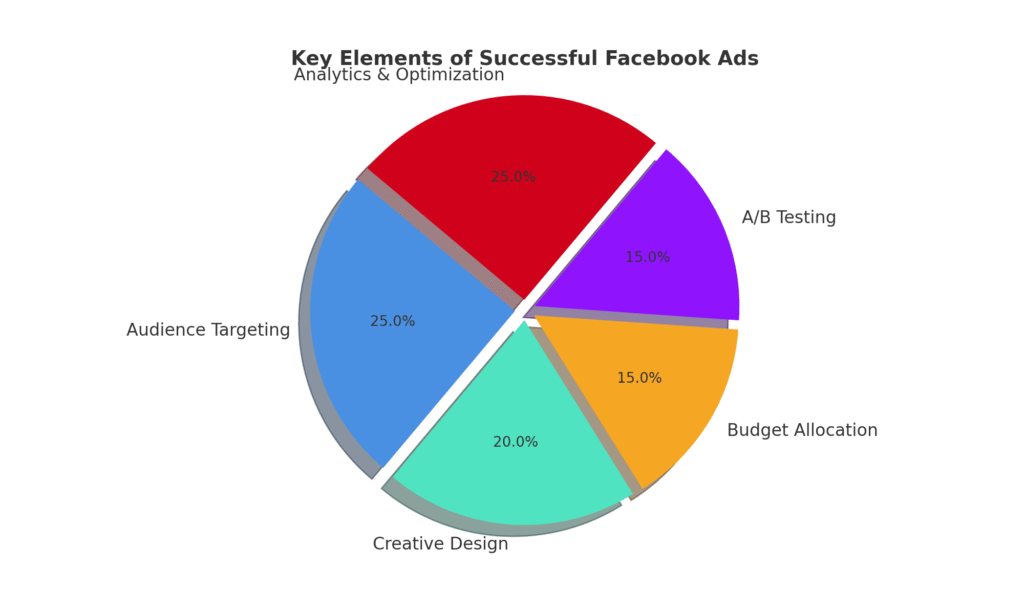
Key Takeaways:
- Match your goals to the right campaign type (traffic, lead gen, conversions, etc.) in Facebook’s interface.
- Use audience insights and segmentation to tailor messages.
- Embrace video and interactive formats (Reels, carousels) for higher engagement.
- Let Facebook’s AI tools help with targeting and budgeting.
- Monitor ROI metrics (CPA, ROAS) and adjust quickly.
- Stay compliant and leverage first-party data and tracking APIs.
By combining these tactics—grounded in data and boosted by AI—advertisers can keep Facebook ads working effectively in 2025 and beyond. Remember that no strategy is one-size-fits-all; continually refine based on your own campaign results and stay agile as the platform evolves.
Conclusion
Facebook Ads remain a cornerstone of digital marketing because of their vast reach and sophisticated targeting. In 2025, success hinges on leveraging Facebook’s latest tools (AI-powered automation, video formats, privacy-safe tracking) while sticking to marketing fundamentals (clear goals, audience focus, testing). According to industry experts, advertisers who combine platforms (e.g. search plus social retargeting) see the biggest ROIswydo.com.
Whether you’re running small-business campaigns or large-scale brand ads, the key is to be strategic and data-driven. Use the statistics and strategies above as a roadmap. Have a clear objective for each campaign, and use Facebook’s metrics to learn and improve. If your competitor is on Facebook (and they almost certainly are), you’ll need to match or exceed their creativity and precision to stand out.
Are you running Facebook ads? What strategies have worked (or not) for your business? Share your experiences in the comments below. And if you’re just getting started, our Facebook Marketing guide has more deep-dive tactics to help you craft winning campaigns. Happy advertising, and may your ROI be ever in your favor!

